
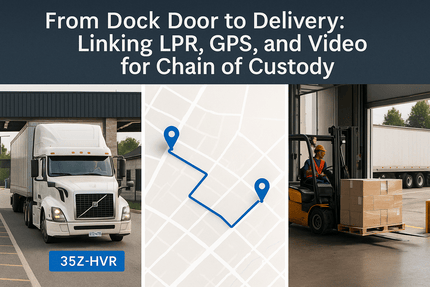
Every handoff in the supply chain is a trust moment. A pallet leaves a dock door, crosses the yard, passes the gate, hits the highway, stops at a cross-dock, and lands at the customer. If you cannot prove what happened at each step, you invite claims, delays, and finger-pointing. The fix is to connect three data sources that already exist at most logistics sites. License Plate Recognition at the gate, GPS and telematics on the vehicle, and synchronized video surveillance at key touchpoints. Tie them together and you get a clean, time-stamped chain of custody that strengthens cargo protection and speeds resolution when something goes wrong.
At SSP, we help distribution centers, fleet yards, and carriers build this evidence pipeline without slowing operations. Here is how it works and what to measure.
k
k
Why chain of custody breaks down
Common gaps we see across logistics facility security:
-
The gate log is manual or incomplete.
-
Vehicle telematics are not reconciled with yard events.
-
Camera footage is stored, but not linked to specific loads or vehicles.
-
Cross-docks and last-mile handoffs lack consistent evidence.
-
Claims teams spend hours pulling data from different systems.
When LPR, GPS, and video live in separate silos, investigators cannot build a simple timeline. That is where an integrated approach pays for itself.
k
k
The evidence stack at a glance
LPR at the perimeter
Reads plates at approach and exit. Confirms the tractor or box truck that presented at the gate. Creates a searchable, time-stamped entry tied to the lane and camera angle.
GPS and telematics on the vehicle
Confirms unit ID, driver assignment, ignition status, geofence crossings, dwell times, and route adherence. Supplies continuous location between facilities.
Synchronized video surveillance
Captures the load at dock release, seal application, yard moves, and gate crossings. Provides visual proof that matches the plate read and the telematics event.
Unified record in a command platform
A single incident ID or load number that holds the LPR event, the video clip, and the GPS breadcrumb for each step. This is the heart of reliable supply chain visibility.
k
k
The workflow from dock door to delivery
-
Dock release
The load is closed and sealed. The dock camera bookmarks a short clip and writes the seal number in the note field. The WMS or TMS assigns the outbound vehicle. -
Yard move
A yard truck or the assigned tractor connects to the trailer. Yard cameras and interior bay cameras capture the hook. A yard geofence logs the move start and stop. -
Gate departure
The tractor approaches the gate. LPR reads the plate before the stop bar. The system checks that the plate matches the expected unit and that the seal number is on file. The barrier opens and a video clip is attached to the departure record. -
In transit
GPS and telematics provide turn-by-turn location, speed, stops, and geofence crossings for cross-docks or scheduled breaks. If a door sensor opens outside a service geofence, an alert is raised and the nearest camera or body-worn feed is requested if available. -
Arrival and delivery
At the destination, inbound LPR confirms the vehicle. Dock cameras or mobile capture validate seal integrity and unloading. The chain of custody closes with a delivery time-stamp that matches the carrier’s ELD and the customer’s receiving system.
The result is a single timeline with visual proof and machine data at every handoff.
kk
k
What this delivers for operations and risk teams
-
Faster claims resolution
Provide a link with gate footage, plate read, and telematics for the exact time window. Carriers and shippers stop debating and start solving. -
Reduced shrinkage and tampering
Door events and off-route stops trigger real alerts, not guesses. Evidence is attached automatically, which discourages opportunistic theft. -
Accurate detention and billing
Dwell time is calculated from geofence and LPR events instead of handwritten logs. Disputes drop and revenue leakage is reduced. -
Cleaner audits
Regulators and insurers get consistent retention, seal verification, and access logs. Transportation facility security is demonstrable, not theoretical.
k
k
Design tips that make the system reliable
At the dock
-
Aim cameras to show the trailer door, seal, and pallet face.
-
Use scene bookmarks linked to load or seal numbers in the VMS notes field.
-
Add a simple light cue or on-screen text overlay for seal application.
In the yard and at the gate
-
Place LPR cameras to read plates before braking so glare does not obscure digits.
-
Maintain stable lighting and a plate-friendly angle.
-
Use both front and rear reads for tractors and straight trucks.
On the road
-
Validate GPS accuracy under bridges and dense areas.
-
Use door and cargo sensors for high-value loads.
-
Define route and stop geofences to prevent alert fatigue.
In the platform
-
Store the LPR event, the video clip, and the GPS breadcrumb under one record keyed to the load or trailer ID.
-
Provide a one-click export that packages clips, maps, and logs for investigators.
k
k
KPIs to prove value in the first month
-
Time to assemble evidence for a claim
-
Percentage of loads with complete dock, gate, and arrival clips
-
LPR first read success rate at departure and arrival
-
Off-route or unscheduled stop alerts per thousand trips
-
Average dwell time at cross-docks and customer sites
-
Detention disputes resolved using unified evidence
These metrics show both security impact and operational payoff.
k
k
Common pitfalls and how to avoid them
-
Unlabeled video
If clips are not tagged with load or seal numbers, investigators still hunt. Use barcode scans or dropdown fields to standardize notes. -
Mismatch between vehicle and plate records
Keep allow lists and fleet records current. Automate syncs from the TMS so the right unit is expected at the right time. -
Gaps at partner facilities
When a customer site lacks cameras, rely on mobile capture and ensure your arrival LPR and GPS still close the loop. Offer a lightweight kit for key partners. -
Retention too short for claims cycles
Align video and log retention with insurance and customer dispute timelines. Archive critical loads automatically.
k
k
Where this fits in the broader security stack
Linking LPR, GPS, and video is a core piece of supply chain protection. It complements access control inside the building, emergency communication for incidents, and perimeter detection for after-hours risk. For multi-site networks, a PSIM or unified command platform keeps everything visible in one dashboard so your team works from a single source of truth.
k
k
The SSP approach
SSP designs and supports integrated solutions that make chain of custody simple, searchable, and strong. We bring together LPR at the gate, GPS and telematics feeds, VMS bookmarking, and a command platform that automates the packaging of evidence. Our 24 by 7 support keeps the system healthy so you do not discover gaps when a claim arrives.
Discover how SSP keeps transportation systems secure and operational.
Contact us to schedule a chain of custody design session for your distribution network.

