
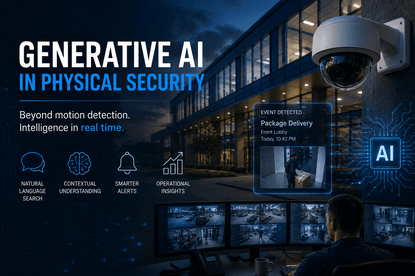
For years, physical security has followed a familiar pattern.
Organizations invested in higher-resolution cameras, expanded access control systems, improved intrusion detection, and added more sophisticated monitoring tools. Each advancement made security programs more capable, yet one fundamental challenge remained largely unchanged.
Security systems collect an extraordinary amount of information, but very little of it becomes actionable intelligence.
A manufacturing facility with 300 cameras may generate thousands of hours of video every week. A hospital, university, distribution center, or corporate campus produces an equally overwhelming stream of footage and access events. While these systems faithfully record what happens, security teams simply do not have the time or resources to continuously watch every camera, investigate every alert, or manually search hours of archived footage after an incident occurs.
For decades, that limitation has shaped how organizations approached physical security. Cameras recorded evidence. Access control documented who entered a facility. Video analytics helped reduce some of the workload, but they still relied on predefined rules and carefully configured conditions.
Generative AI is beginning to change that equation.
Not because it replaces cameras or security professionals, but because it changes the role of the security system itself. Instead of simply collecting information, modern platforms are beginning to understand it.
That distinction represents one of the most significant advancements our industry has seen in years.
Why Traditional Video Analytics Could Only Go So Far
Artificial intelligence is not entirely new to physical security.
Many organizations already use AI-powered cameras that distinguish people from vehicles, reduce nuisance alarms from weather or animals, recognize license plates, or identify faces in authorized applications. These technologies have delivered meaningful improvements over traditional motion detection and continue to provide tremendous value.
However, these systems are generally designed to answer relatively straightforward questions.
Is this a person?
Is this a vehicle?
Did someone cross this virtual line?
Has an object remained in this area longer than thirty seconds?
These rule-based analytics are highly effective when the event being monitored is clearly defined in advance. The challenge is that real-world environments are rarely that predictable.
Consider a loading dock.
A conventional analytic might detect that someone entered the area after business hours. It may recognize a truck arriving at the dock or alert when motion occurs inside a restricted zone.
What it cannot easily determine is whether a delivery was left unattended, whether pallets are blocking an emergency exit, whether employees are following required safety procedures, or whether activity occurring at the dock is normal for that time of day.
Those situations require context, not just detection.
Generative AI Is About Understanding, Not Just Seeing
The emergence of vision-language models is fundamentally changing how video systems interpret the world around them.
Rather than relying exclusively on predefined rules, generative AI combines computer vision with natural language understanding. Instead of asking whether certain pixels changed inside a designated area, the system evaluates relationships between people, objects, and activities to answer a much more useful question:
What is happening here?
That difference may sound subtle, but it represents a major leap in capability.
Instead of programming dozens of analytic rules, a security administrator can describe the event they care about in plain language.
For example:
- Notify me when a package is left at the reception desk.
- Alert me if an emergency exit becomes blocked.
- Tell me when a delivery truck remains at the loading dock longer than thirty minutes.
- Notify security if someone appears to be loitering near the main entrance after closing.
- Alert me if employees enter a production area without required personal protective equipment.
The system interprets those requests, continuously evaluates live video, and generates alerts when the described activity occurs.
For security professionals, that means spending less time configuring complex analytic rules and more time solving operational problems.
Moving Beyond Security Incidents
One of the biggest misconceptions surrounding generative AI is that it exists solely to improve security.
In reality, many of its most valuable applications extend well beyond traditional security operations.
Organizations have already invested heavily in camera infrastructure. The question is no longer simply how to protect buildings, but how to extract more value from the systems already in place.
A manufacturing facility might use AI to identify recurring safety concerns before they become OSHA violations.
A healthcare provider could receive notifications when equipment obstructs patient corridors or when restricted medication storage areas experience unusual activity.
Educational institutions can monitor doors that are repeatedly propped open, identify after-hours activity requiring attention, or improve campus safety without increasing staffing levels.
Distribution centers may identify bottlenecks at loading docks, detect improperly staged inventory, or recognize unsafe forklift interactions.
Property managers can identify illegal dumping, overflowing waste containers, unauthorized pool access, or maintenance issues before tenants submit complaints.
None of these examples replace human decision-making.
Instead, they reduce the amount of time spent searching for problems that cameras have already recorded.
The conversation shifts from "What happened?" to "Tell me when something important happens."
Separating Marketing Buzzwords from Meaningful Innovation
The term "AI" has become one of the most overused phrases in technology.
Nearly every security manufacturer now promotes AI-powered products, making it increasingly difficult for organizations to distinguish genuine innovation from marketing terminology.
That skepticism is understandable.
Many earlier "AI" features were essentially improved object classifiers. They provided valuable enhancements over motion detection but still required administrators to define every condition the system should monitor.
Generative AI represents a different category altogether.
Rather than simply identifying objects, these systems begin interpreting activities, relationships, and context.
That doesn't mean every product marketed as "generative AI" delivers the same capabilities. Organizations evaluating new solutions should ask practical questions rather than focusing on product labels.
Can the platform understand natural language requests?
Can it search recorded video using conversational prompts?
Can it identify complex activities rather than isolated objects?
Can it integrate with existing camera infrastructure?
Can alerts be customized without extensive engineering or scripting?
Ultimately, successful AI deployments are measured by operational outcomes—not by the number of AI features listed on a specification sheet.
A Practical Example: Brivo's Eeva AI
One example of this new generation of technology is Brivo's Eeva, an AI-powered video assistant built into the Brivo ecosystem.
Rather than requiring administrators to configure numerous analytic rules, Eeva allows users to describe the situations they want detected using conversational language. The platform analyzes video, searches historical footage using natural language, and creates alerts based on contextual understanding instead of rigid programming.
Imagine a receptionist who wants to know whenever deliveries are left on a designated package table.
Instead of configuring multiple zones, object classifications, timing thresholds, and motion rules, they simply describe the desired outcome.
Likewise, a facilities manager could search archived video by asking questions such as:
"Show me every time someone entered this room carrying a ladder."
"Find instances where pallets blocked this emergency exit."
"Show deliveries made after business hours."
The technology translates those requests into video searches that previously required significant manual effort.
While platforms like Eeva illustrate where the industry is heading, the broader trend is more important than any individual product. Security systems are evolving from passive recording devices into intelligent operational tools capable of helping organizations find information, recognize patterns, and prioritize meaningful events.
Generative AI Still Has Limits
Despite the excitement surrounding generative AI, it is important to approach the technology with realistic expectations.
No AI platform is infallible.
Camera placement still matters. Lighting conditions still matter. Image quality still matters.
A poorly positioned camera overlooking a dark loading dock will not suddenly produce reliable insights because generative AI has been added to the system.
Likewise, AI should not replace professional judgment.
Security personnel remain responsible for evaluating alerts, making operational decisions, and responding appropriately. AI can dramatically reduce the amount of routine monitoring required, but it should augment experienced professionals rather than replace them.
Organizations should also evaluate cybersecurity practices, privacy policies, data retention strategies, and governance procedures before deploying AI-enabled security technologies. As these systems become more capable, responsible implementation becomes just as important as technological capability.
The most successful deployments treat generative AI as another tool within a comprehensive security strategy—not as a standalone solution.
What Organizations Should Be Asking Today
As interest in generative AI continues to grow, many organizations naturally begin by asking which platform offers the most advanced AI capabilities.
That is rarely the best starting point.
A better question is:
What operational problems are we trying to solve?
Is your security team overwhelmed by reviewing recorded video after incidents occur?
Do facilities personnel spend hours searching footage to investigate deliveries, maintenance concerns, or safety issues?
Are there repetitive events your cameras already capture but no one has the capacity to monitor consistently?
Can existing security investments provide greater operational value without expanding headcount?
Organizations that answer these questions first are far more likely to realize measurable returns from AI-enabled security technologies.
Technology should support business objectives—not become one.
Looking Ahead
Physical security has always been about protecting people, property, and operations.
Generative AI does not change that mission. It changes how effectively organizations can accomplish it.
The next generation of security systems will not simply record events or generate more notifications. They will help security teams understand what is happening across their facilities, surface meaningful information from enormous amounts of data, and enable faster, more informed decisions.
For organizations evaluating the future of physical security, the conversation is no longer limited to camera resolution, storage capacity, or access credentials. Increasingly, the discussion centers on how intelligently those systems can interpret the environments they protect.
As the technology continues to mature, the organizations that benefit most will not necessarily be those with the largest number of cameras. They will be those that transform those cameras from passive recording devices into sources of actionable intelligence.
At SSP, we believe that successful technology deployments begin with understanding an organization's operational goals—not simply recommending the newest feature set. Generative AI is an exciting advancement, but its greatest value comes when it is thoughtfully integrated into a broader security strategy that supports safety, efficiency, and informed decision-making across the entire organization.

