
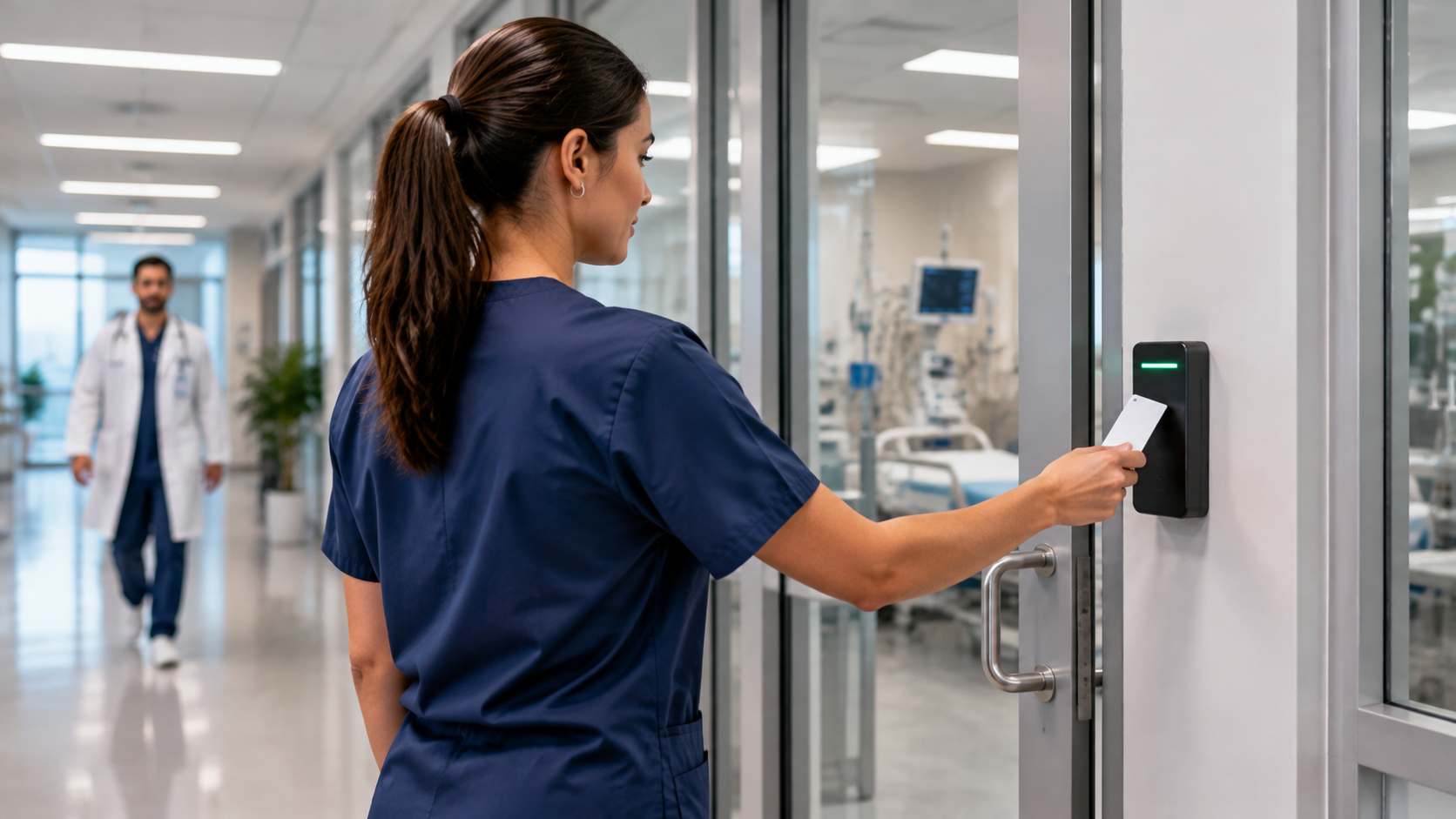
Hospitals have always needed to balance open access with controlled spaces. Patients, visitors, clinicians, contractors, and vendors all need to move through a facility, but not everyone should be able to enter every area. Recent industry research suggests healthcare security teams are putting renewed attention on how that balance is managed.
In Genetec's healthcare findings from its 2026 State of Physical Security Report, 55% of respondents identified access control as a project focus for 2026, ahead of AI (40%) and video surveillance (39%). The same research found respondents reporting increases in physical attacks on employees (55%), unauthorized entry (50%), and break-ins (47%). These are survey responses about rising incidents, not the percentage of facilities experiencing an incident. Source: Genetec's healthcare findings, January 2026.
For healthcare security directors, the useful question is not simply whether to add more readers or replace a platform. It is which access problems need solving, and how to do that without interfering with clinical care or life-safety requirements.
Where access control makes the biggest operational difference
Medication storage and restricted clinical spaces
Pharmacies, medication rooms, laboratories, and other restricted areas need access rules that reflect staff roles and changing schedules. Individual credentials, appropriately configured permissions, and timestamped access logs can support investigations when an unexpected entry or inventory discrepancy occurs.
Those records are valuable, but an access event does not prove what someone did inside a room. Video, inventory controls, procedural safeguards, and appropriate investigation practices may also be necessary. Access control is one part of a broader accountability process, not a substitute for it.
Behavioral health and patient safety
Behavioral health areas present a different challenge. Facilities may need to monitor or control movement to reduce unauthorized departures while preserving safe evacuation and required emergency release functions. Door hardware, locking arrangements, staff workflows, and fire/life-safety interfaces must be evaluated together.
A configuration that seems secure on paper may create operational problems if staff cannot respond quickly or if an emergency release behaves unexpectedly. These areas call for site-specific design, coordination with clinical and life-safety stakeholders, and documented testing.
Emergency departments and public entrances
Emergency departments operate around the clock and cannot function like ordinary office buildings. Public entrances, treatment zones, staff-only corridors, and sensitive rooms often need different access rules. Visitor management, intercoms, duress devices, and access control can work together, but each integration needs a defined purpose and response procedure.
Rather than starting with a product list, ask where unauthorized movement is most likely, which staff need immediate access, and what should happen when an alarm or emergency occurs.
What workplace violence prevention means for security planning
Workplace violence is a serious concern in healthcare, and physical security improvements can be part of a facility's prevention program. OSHA has published guidance for healthcare and social service workers and has pursued rulemaking on workplace violence prevention. However, as of November 2026, OSHA's nationwide healthcare-specific standard remains in the proposed-rule stage, not a finalized rule that mandates a particular access control installation. Source: OSHA's current regulatory agenda.
Healthcare organizations should assess applicable federal, state, and local requirements separately. Regardless of regulatory status, a documented assessment of incidents, vulnerable entrances, staff workflows, and response procedures can help prioritize investments. A psychiatric unit, outpatient clinic, and large acute-care hospital will not necessarily need the same controls.
Cloud, on-premises, or hybrid: choose based on the facility
Healthcare organizations are also reconsidering how access control is managed. Centralized administration can simplify credential updates across campuses, while integrations with HR or visitor systems may reduce manual steps. Genetec's research highlights continued interest in hybrid-cloud flexibility rather than a single deployment model for every organization.
Cloud-managed platforms may be attractive for multi-site administration and software maintenance. On-premises systems may remain appropriate where existing infrastructure, local control, connectivity, or organizational policies favor that approach. Hybrid architectures can offer another option, depending on product capabilities and integration requirements.
Whichever model is selected, teams should confirm how doors operate during internet or server outages, how credentials are synchronized, who can make changes, and what support arrangements are available. A platform's architecture matters less than whether it performs reliably under the facility's actual conditions.
Where integration and analytics can help
Modern access control systems can share information with other authorized business and security tools. For example, an approved HR integration may help revoke credentials when employment ends, while visitor management can support time-limited access to defined areas. These workflows depend on system compatibility, configuration, and governance.
Analytics may also help teams review unusual after-hours access or other patterns worth investigating. Such alerts are leads for human review, not proof of misconduct. Healthcare organizations should account for privacy, data access, false positives, and the operational burden of responding to alerts before deploying new analytics.
Five questions to ask before the next access control project
- Which incidents or operational gaps are we trying to reduce, and where do they occur?
- Which doors and departments need different access rules, emergency behaviors, or visitor workflows?
- How will access control interact with fire alarm, egress, clinical operations, and emergency response procedures?
- Can existing equipment be retained, and which integrations are actually supported?
- Who will maintain permissions, review exceptions, test critical functions, and support the system after installation?
The strongest healthcare access control projects begin with an understanding of how a facility operates. Technology choices follow from that work, not the other way around.
Southeastern Security Professionals works with healthcare organizations on access control design, installation, integration, and ongoing support. Talk to an SSP specialist about evaluating your facility's access control needs.
Research reference: Genetec, 2026 State of Physical Security Report healthcare findings. Survey findings describe respondent priorities and reported increases, not universal outcomes for all healthcare facilities.