
Originally published May 21, 2025. Restored and reviewed November 19, 2026.
Municipal buildings, including courthouses, city halls, police departments and public works facilities, support daily government operations. Public access, aging infrastructure and busy entrances can make protecting those spaces complicated.
The original SSP article examined five recurring security concerns and practical ways to address them. The same approach applies today: understand how the building operates, then combine appropriate technology with clear procedures and trained staff.
1. Unauthorized Access and Tailgating
The concern: Visitors, contractors and staff may share public entrances while needing very different access to the rest of the building. Someone following an authorized employee through a controlled door can bypass a credential check.
Practical prevention:
- Separate public service areas from staff offices, records storage and other restricted spaces.
- Use appropriately configured badge or mobile-credential access control, with additional authentication where the risk assessment and supported technology warrant it.
- Consider compatible anti-tailgating detection at selected entrances. Alerts need a defined response, not just another notification.
- Use visitor management and escort procedures that fit the facility's public-service obligations.
Door hardware and entry procedures must preserve required accessibility and emergency egress. Access control does not replace those requirements.
2. Vandalism and Theft of Public Property
The concern: Maintenance yards, vehicle depots, parking areas and storage rooms can be difficult to supervise continuously. Theft or damage can interrupt services as well as create replacement costs.
Practical prevention:
- Plan video surveillance around entrances, vehicle routes and assets, accounting for lighting, viewing angles and the level of detail needed.
- Use suitable exterior equipment and test nighttime performance rather than assuming every camera provides usable evidence.
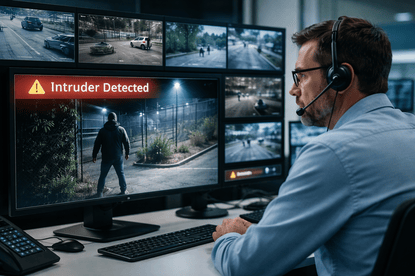
- Consider intrusion detection and professionally monitored or staff-reviewed alerts for defined areas and schedules.
- Combine visible security measures with lighting, maintained gates and clear incident-reporting procedures.
Cloud, on-premises and hybrid recording can each be appropriate. Choose retention, access permissions and monitoring arrangements around the agency's needs and policies; cloud storage is not a requirement for every project.
3. Misuse of Employee or Contractor Access
The concern: Outdated permissions, shared credentials and access that remains active after a role or contract ends can expose restricted spaces. These gaps can arise through poor administration as well as deliberate misuse.
Practical prevention:
- Assign permissions by job function and limit access to the locations and times needed.
- Define who issues, changes and disables credentials when employment or a contract ends.
- Review permissions on a documented, risk-appropriate schedule and after significant personnel changes.
- Review relevant access events and exceptions under the agency's privacy and retention policies.
Access logs support investigation, but a credential event is not proof of misconduct. Human review and other evidence may be needed. SSP's service and support can help address system reliability and administration needs within an agreed scope.
4. Workplace Violence and Public Disputes
The concern: Public meetings, service disputes and confrontations can place front-line employees in difficult situations. A reception counter, public meeting room and restricted office may each need different response arrangements.
Practical prevention:
- Evaluate duress buttons or other discreet ways for staff to request help, with a tested response and escalation process.
- Use video intercoms and security communications where they help staff screen entry to restricted areas.
- Plan appropriate coverage of public spaces, with authorized access to recordings and a clear retention policy.
- Coordinate technology with staff training, incident reporting and emergency procedures.
Alerts and cameras cannot guarantee prevention or immediate response. Regular drills and functional testing help staff understand what will happen when assistance is requested.
5. Cyber-Physical Risks in Connected Systems
The concern: Network-connected cameras, access-control servers and other building systems can create additional exposure if they are poorly configured or maintained.
Practical prevention:
- Coordinate network segmentation and firewall rules with the agency's IT team. A dedicated VLAN alone is not a complete security boundary.
- Use individual administrator accounts, appropriate privileges, strong authentication and controlled remote access.
- Maintain an inventory of supported equipment and software, and plan manufacturer-recommended updates with testing and rollback procedures.
- Confirm how critical doors, alarms and recording behave during network or server outages.
- Review procurement and information-security requirements for the actual project. NDAA restrictions and CJIS requirements have specific scopes; neither is a universal product certification for every municipal installation.
Manufacturer guidance, such as the Avigilon System Hardening Guide, can inform a supported system's configuration. Apply guidance for the actual product and version, alongside the agency's own security requirements.
A Proactive, Layered Security Approach
Useful security planning brings physical measures, procedures and technology together. Start by identifying the building's public areas, sensitive spaces, operational constraints and response responsibilities. That makes it easier to prioritize improvements that solve real problems.
Southeastern Security Professionals works with public agencies on government security and life safety systems, including design, installation, integration and ongoing support. Talk with SSP about your facility's existing systems, recurring concerns and next steps.